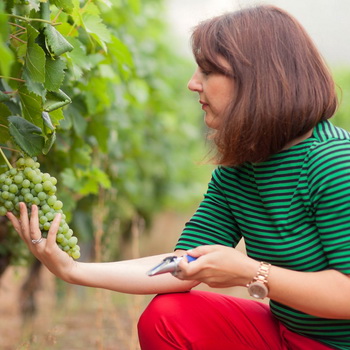
A very interesting article from Katerina Karampatea who is scientific associate in the Department of Agricultural Biotechnology & Oenology. She is working as consultant oenologist in Oenopolis Oenological Laboratory and also is winemaker in the Domaine de la Rose Rouge.
The vine (Vitis vinifera L.) is one of the most widely cultivated species in the world. About 12500 varieties have been registered in the Vitis International Variety Catalog (VIVC). However, based on their DNA profiles, the number of vine varieties is estimated to be around 5000, and according to research, many of the varieties are closely related [P. Sancho-Galán et al., 2019].
Most countries plant 70-90% of their total area with the same 12 varieties, representing 1% of the total diversity. In general, climate change affects the ripening of grapes, "premature" the harvest by 10 to 24 days, the last 30-50 years, thus leading to overripe grapes. As a result, the must produced has high potential alcohol by volume, higher pH, lower acidity and low levels of easily assimilable nitrogen.
Given the total area of the Greek vineyard, the small Greek average vineyard ownership (3.95 acres), that Greek wine production represents about 1.26% of total European wine production and that Greece is the 17th wine-growing country in the world, we understand the place of Greek wine in the international foreground. Greek wine production in 2020 (2 mhl) show a negative variation with respect to 2019 (-2%) and its last five-year averages (-17%)[OIV 2020-world-wine-production-first-estimates].

There are more than 300 Greek indigenous varieties that are cultivated single or in combination with international varieties in 9 different wine-growing Greek regions (mainland and islands), in soils that vary strongly, with altitudes starting from the sea surface and reaching over 1,000m. Greece has 33 PDO zones and more than 120 PGI zones.
In an international environment where the competitiveness and commerce of wines worldwide is huge, Greek agriculture has relatively high production costs and intense competition from already established wine-producing countries or those of the new wine world. There is great interest in creating typical products with a strong character and / or in relation to geographical names [A. Karampatea et al., 2021]. Value creation is one of the most important challenges for winemakers. It relies on the wine's ability to satisfy consumers in the long run. Thus, a wine must be able to seduce immediately and in the long term, from the first sip to the last, without being boring to the consumer. Sensory complexity is a critical indicator of quality [D. Dubourdieu et al., 2011] and the concept of wine complexity is increasingly of interest to scientists, winemakers and wine lovers.
Photo Credit: Wines of Greece