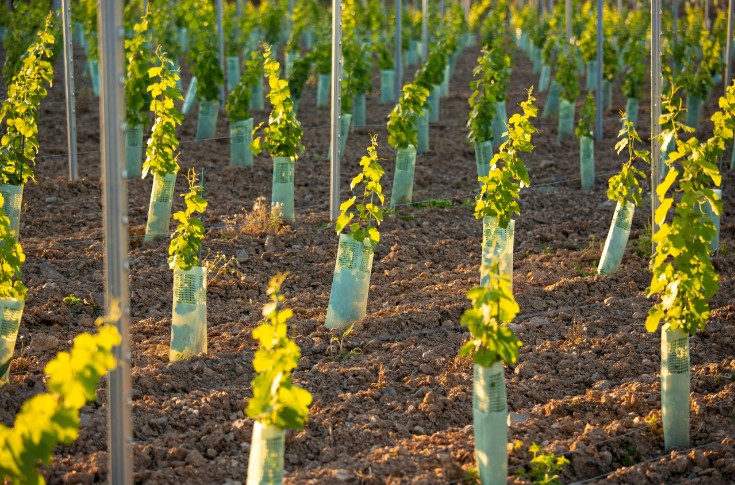
The decree of 23 July 2026 definitively classifies several varieties, each allowing an 80 to 90% reduction in treatments against mildew and powdery mildew.
First, six ResDur 3 varieties from the French National Research Institute for Agriculture, Food and the Environment (INRAE) and Agroscope in Changins, unveiled at the last Agrovina exhibition in Switzerland, and all of which have at least two resistance genes against the two main fungal diseases of vines. These are, in white, the varieties Elaris (from the cross of IRAC-1933 and Col-2024G), Florisia (Voltis x Divico), Orellis (IRAC1-933 x Col-2024G), and Serelis (Artaban x Bronner), and, in red, the varieties Taranis (IRAC-1933 x Voltis) and Valpesia (Col-2024G x Divico).
Then, five Bouquet varieties also developed by INRAE from the work of crossing emblematic grape varieties of the Mediterranean basin with resistant wild Muscadinia rotundifolia vines carried out by the late professor. These are, in white, the Bouquet 3159 variety (descendant of Chasan) and, in red, Bouquet 3160 (from Fer Servadou), 3176 and 3179 (from Grenache noir), and 3196 (or G9, from Italia table grapes), all available to order since their registration in the official catalogue last February for the 2026-2027 winter plantings. After heated debates, these varieties obtained by Alain Bouquet have kept their code names.
Sparkling wines and old grape varieties
The decree of 23 July 2026 also classifies the white Calardis resulting from a cross between the Calardis Musqué and the Seyve Villard 39-639 carried out by the Julius Kühn Institute at the Geilweilerhof in Siebeldingen, Germany, and particularly well suited to the production of sparkling wines.
The text finally gives the green light to the planting, vinification, and marketing of six heritage grape varieties, with, in white, Bonne Vituaigne (originally from Ardèche), Cacaboué (Savoie), the very old Gouais blanc, its Franche-Comté cousin Gueuche noir, and the Ardèche Pougnet and Ribier noir.
Source: Vitisphere