Abstract
Rootstocks are an important means of adapting grapevine to environmental conditions whilst conserving the typical features of scion genotypes. Rootstocks not only provide tolerance to Phylloxera, but also ensure the supply of water and mineral nutrients to the scion. We take advantage of the large diversity of rootstocks used worldwide to facilitate this adaptation. The aim of this study was to characterise rootstock regulation of scion mineral status and its relationship with scion development.
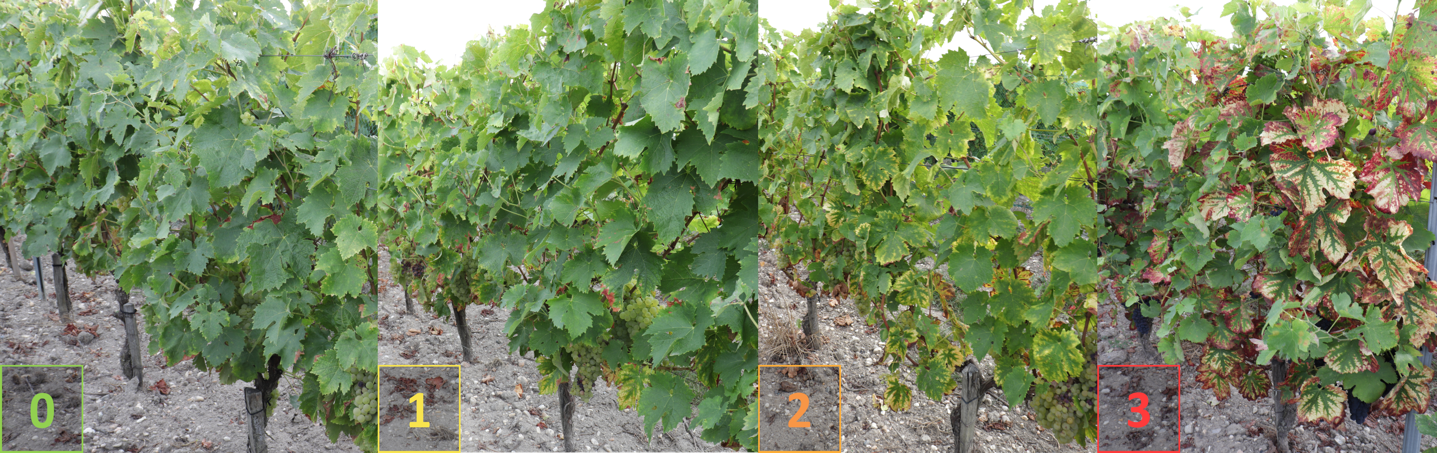
Vitis vinifera cvs. Cabernet-Sauvignon, Pinot noir, Syrah and Ugni blanc were grafted onto 55 different rootstock genotypes and planted as three replicates of five plants in sandy gravelly soil near Bordeaux, France. In 2020 and 2021, petiolar concentrations of 13 mineral elements (N, P, K, S, Mg, Ca, Na, B, Zn, Mn, Fe, Cu and Al) were measured at veraison. Winter pruning weight, shoot vigour, leaf chlorophyll content, bud fertility and yield were measured. Magnesium deficiency severity was visually scored for each plant. Rootstocks were grouped according to their Vitis parentage background when at least 50 % of a Vitis species was present in order to determine whether the petiole mineral composition could be related to the rootstock genetic parentage.
Scion, rootstock, and their interactions had a significant influence on petiole mineral content and explained the same proportion of phenotypic variance for most mineral elements. Rootstock effect explained 9, 28 and 45 % of the mineral content variance for N, Mg and S respectively. This unique experimental design showed that the rootstock effect was higher than the scion effect on the petiole concentration of a large majority of mineral elements. The genetic background V. riparia increased the probability of low petiolar P and Mg contents. The severity of Mg deficiency symptoms varied depending on the rootstock. The differences in mineral status conferred by rootstocks were not significantly correlated with vigour or fertility.
The evaluation of Mg levels by petiole analysis and the intensity of deficiency symptoms showed for the first time the variability of the thresholds of satisfactory mineral nutrition between rootstocks. Therefore, fertiliser management should take the rootstock variety into account.
Introduction
Since the late 19th century, grapevine has been grown grafted in most of the world largely because of Phylloxera (Daktulosphaira vitifoliae). Rootstocks allow tolerance to phylloxera, but they also play a major role in water and mineral nutrient absorption, as reviewed by Ollat et al. (2016). They strongly interact with scion genotypes and modify whole plant development through the modification of yield and vigour in an environmentally dependent manner (Tandonnet et al., 2010; Tandonnet et al., 2008; Tardáguila et al., 1995). Differences in rootstock behaviour have a strong influence on grape growers' choice for soil adaptation, yield, fertiliser requirements and canopy management (Ibacache et al., 2020). Rootstocks play an important role in adaptation to environmental conditions when aiming to conserve the typical features of the currently used scion genotypes.
Plants absorb elements from the soil and atmosphere and incorporate them into their tissues. Mineral elements can be classified in two categories: macroelements and microelements (Maathuis, 2009). Macroelements, such as nitrogen (N), phosphorus (P), potassium (K), magnesium (Mg), sulphur (S) and calcium (Ca), represent the major requirements of plants in terms of quantity. They are required for structural roles, as well as energy metabolism, protein and nucleic acid synthesis, osmotic adjustment, ion homeostasis and signalling. By contrast, microelements, such as boron (B), zinc (Zn), manganese (Mn), iron (Fe), copper (Cu) and aluminium (Al), are essential for plant development, but are required in low quantities as catalytic elements involved in metabolic reactions, such as enzymes or cofactors (Marschner, 2012).
Mineral deficiencies and toxicities exist in viticulture and they can have a strong negative impact on vegetative development, fruit development and yield (Bavaresco et al., 2010). Deficiencies can be due to the lack of a mineral or induced by other parameters, such as an excess of a competitive mineral, an inappropriate soil pH or the presence of active limestone for iron. Most of the time, symptoms of deficiency can be visually observed on leaves (Marschner, 2012), but they can be also be observed at whole plant level and with yield-related traits at different seasonal timings, such as early season, blooming, fruit set and veraison (Delas, 2011). When determining plant mineral status, petiole nutrient analysis is a reliable indicator (Schaller, 2008).
Grafting grapevine impacts the mineral content of the different compartments of the plant, such as the shoots, roots, leaves, berries and petioles (Carles et al., 1966; Dalbó et al., 2011; Delas and Pouget, 1979; Pachnowska and Ochmian, 2018). Rootstocks also react differently to fertiliser management, as the response of petiole and leaf mineral content to fertiliser application depends on the rootstock (Delas and Pouget, 1979) and soil characteristics (Fisarakis et al., 2005). In addition, scions differ in tissue mineral content, but few studies have included the analysis of several scions and rootstocks. When different scions and rootstocks are both studied, statistically they are often independently analysed (Dalbó et al., 2011; Ibacache and Sierra, 2009; Kocsis and Lehoczky, 2000; Wolpert et al., 2005). In some cases, the two factors are statistically studied together, but without the assessment of the relative importance of the scion and rootstock factors (Wooldridge et al., 2010). The differences in mineral petiole concentrations induced by the rootstock parentage has rarely been studied; Wolpert et al. (2005) studied the effects of genetic backgrounds on petiole K concentrations, and Gautier et al. (2020) studied the effects of the genetic background on petiole P concentrations. In both these studies, a descriptive approach was used and these studies were based on less than 15 rootstock genotypes.
The first written reference to the impacts of rootstock on foliar deficiency symptoms was done by Bovay and Gallay (1956). Since then, rootstocks have been classified according to their ability to satisfy scion mineral requirements, but this has only been based on petiole mineral content (Cordeau, 1998; Ibacache and Sierra, 2009). The relationship between petiole analyses and deficiency symptoms observed in the field has never been determined. Magnesium deficiency symptoms have been used to describe the behaviour of various scions (Pedò et al., 2019) and rootstocks linked to the percentage of bunch stem necrosis (Spring et al., 2012), but without comparison with tissue mineral analyses (Provost et al., 2021).
The aims of this study were 1) to evaluate the relative effects of the scion and the rootstock on scion petiolar mineral content, using a very wide selection of rootstocks and four scions, 2) to determine whether the scion mineral content is related to the rootstock genetic backgrounds, 3) to characterise the relationship between petiole concentrations and mineral deficiency symptoms by suggesting a new classification of rootstocks, and 4) to study the influence of the Mg deficiency on growth-related traits.
Read more:
The authors