Houses that once insisted their non-vintage never changed are now celebrating the differences between base years. A magnum of Ayala Brut Majeur built on the outstanding 2019 harvest shows why detailed back labels, and extra time under cork, pay off, writes Giles Fallowfield.

There have been a plethora of exciting Champagne tastings over the past six weeks or so, demonstrating, if demonstration was needed, that the quality of wine being produced in the region is generally at a very high level currently, arguably higher than it’s ever been before.
While the major houses were historically always keen to say that the quality and style of their non-vintage, or brut sans année (BSA), offering remained consistently and recognisably the same, year after year, whatever the harvest it was based on, we know that in reality (because the specific attributes of each individual crop do vary) quality and style also vary between different base years. Many houses have even started to deliberately make a feature of this variation – notably Lanson and Roederer – emphasising the differences whether in their regular BSA cuvée or a new separate BSA offshoot.
Reading the back label
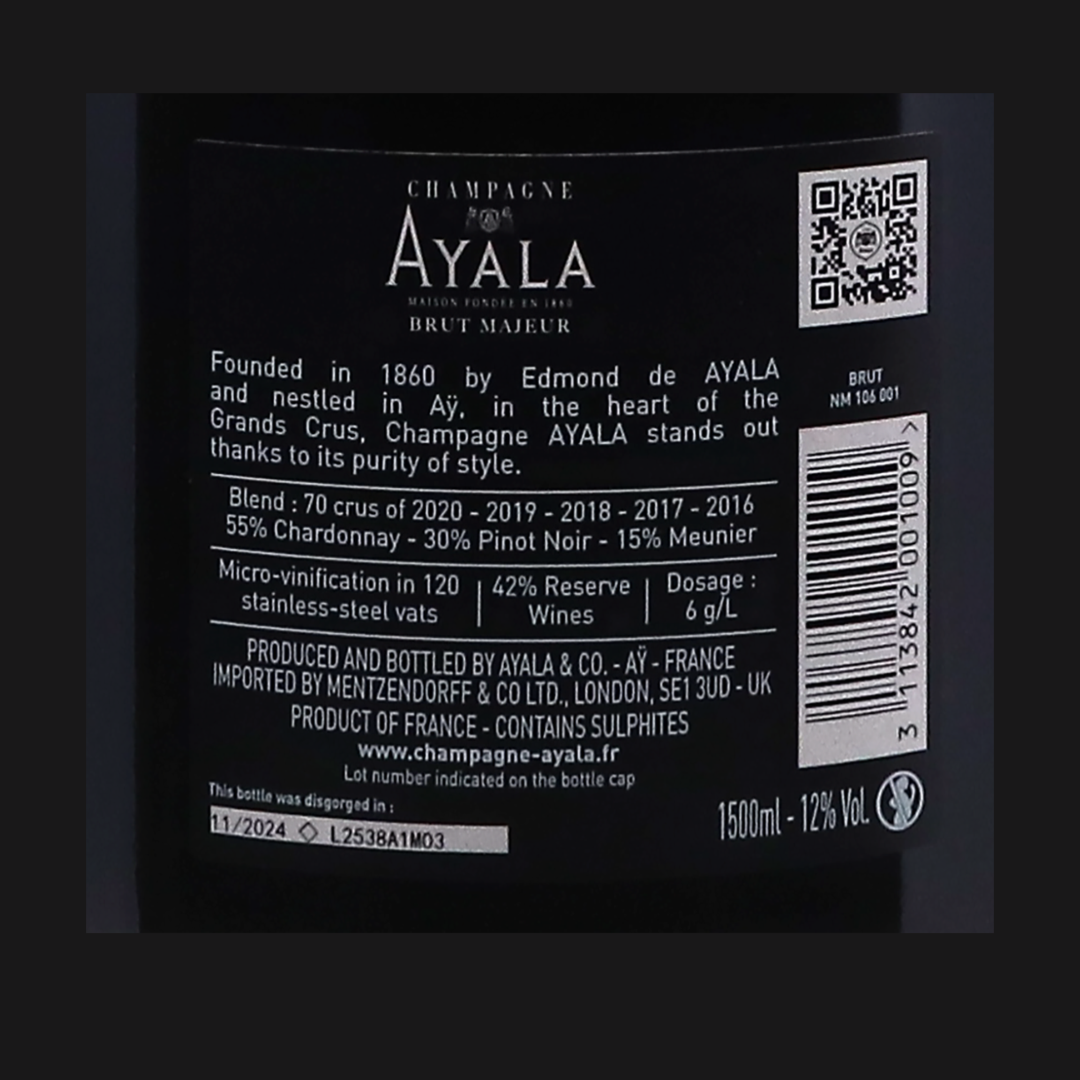
Typically, the regular fiche technique tends to ignore the precise cépage blend and often only claims “a minimum of three years lees ageing” (which is at least an improvement on the appellation’s rather weak minimum standard of 15 months). But several enterprising houses now boast greatly improved back labels, aping the efforts of the best récoltants-manipulants, who often go into great detail there to good effect, showing the precise cépage blend, number of bottles produced, date of disgorgement, percentage of reserve wine, dosage and more.
I was particularly impressed earlier this month, at a tasting of Ayala’s mostly Chardonnay-based wines, by a magnum of its Brut Majeur. Intended, I assume, as a ‘warm-up’ wine, setting the palate for some impressive vintage Blanc de Blancs that followed, it proved to be a standout wine in its own right, showing real depth and mid-palate intensity. Inquiring, we were initially told it was based on the not very brilliant 2021 harvest, although experience suggested that to be unlikely. In fact, it transpired the base year was the very fine, sunny 2019 harvest that some have suggested may turn out to be the best vintage in Champagne of the past two decades.
The magnum’s back label (pictured, bottom) details that the wine is a 55% Chardonnay, 30% Pinot Noir, 15% Meunier blend, coming from 70 different crus across four consecutive harvests, 2019 back to 2016, with 43% of the blend being reserve wine (in other words, coming from the ‘18, ‘17 and ‘16 harvests).
Two decades of disclosure
Ayala is one of the enterprising houses that goes into considerable detail on its back labels. While this level of detail has become a lot more common recently, particularly among the small and medium-sized quality houses on their more premium cuvées, few still put this information on their mainstream BSA bottlings, which account for the vast majority of their sales.
Ayala has championed this level of transparency across its range for more than two decades, a policy that dates back to Hervé Augustin, installed as head of the house by then Bollinger president Ghislain de Montgolfier when Bollinger bought its Aÿ neighbour in 2005.
The benefit of time
The Brut Majeur in magnum spent around four and a half years on its lees before disgorgement in November 2024 and then, importantly, another 23 months on its final cork before we tasted it in mid-October. The rich, texturally complex palate clearly shows that this extra time, plus the amplifying effect of the magnum format, is massively beneficial to decently made Champagne.
In a very timely offer, The Wine Society is discounting Ayala Brut Majeur in bottle until the end of the year, and in magnum and half-bottle formats until 2 November. The magnum blend in this offer is not precisely the same as the one we tasted: the harvest base has moved to 2020, although that was another high-quality crop. The reserve wine element, which makes up 42% of the blend, includes 2019 as well as ‘18, ‘17 and ‘16. Importantly, it was disgorged at the same time as the previous blend, in November 2024, so although it has spent around a year less on its lees, it too should be drinking very well in the coming festive season.
Under The Wine Society deal, a case of three magnums will set you back £177, which works out at £59 a magnum. A single magnum is £76, so the three-magnum case gives a saving of £51.
SOURCE: THE DRINKS BUSINESS