THE VINEYARD OF ATTICA DISAPPEARS.....
In less than five years, if no immediate and effective measures are taken to support the winegrowers of Attica, the country's once largest vineyard with its special historical value and its environmental contribution to the residents of the capital will unfortunately no longer exist.
The causes of this negative development are first and foremost the unacceptably low prices paid for wine grapes due to unfair competition and the absence of market controls.
These prices, combined with the unprecedented reduction in grape production, do not ensure the viability of wine-growing holdings and do not provide financial support for continued cultivation.
The second cause of the decline in the vineyard is the climate crisis, particularly the water scarcity and drought, which for the second year in succession are responsible for the significant reduction in production.
The winter in Attica was quite mild with little but heavy rainfall, which did not manage to water the vines sufficiently. Temperatures were noticeably higher for the season. Spring was also characterised by high temperatures and a complete lack of rainfall, resulting in rapid growth of the vines.
The first month of summer started with very high temperatures and no rainfall which continued in the other months , with the result that the vines, lacking water reserves, stopped growing abruptly. The hail that fell at the beginning of July caused little damage in isolated areas of the Mediterranean. The major fire in north-east Attica affected vineyards in the areas it passed through. It should be noted here that the vineyards were a buffer to the spread of the fire. The prolonged heatwave, which continued for about forty days, forced producers to harvest the vines about fifteen days earlier than in other years.
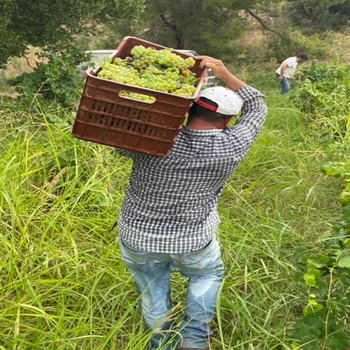
In the white varieties harvested at the beginning of August, the reduction in production was 40% compared to the 2023 harvest (where it was also reduced compared to 2022). In the red varieties harvested just before 15 August, the reduction was even more significant, amounting to 50% of 2023. In Savatiano, which covers about 80% of Attica's production , harvested for the first time in the second half of August, the reduction was significant and at 55-60%.
The quality of the grapes in contrast to their quantity , was extremely good. The alcoholic degree in the white varieties was a little lower this year and averaged about 12.5% , also the balanced acidities will give well structured wines with rich aromas .
The result of the continuous decrease in production year after year , will be the final abandonment of Attiko Vineyard , since now the cultivation of vines is loss making . At the moment the Attica Vineyard is one of the oldest vineyards in Europe , the largest single vineyard in Greece and perhaps the last source of greenery left in Attica , after all the devastating fires of recent years .
We are at 5 minutes and 5 minutes.
If no immediate measures are taken NOW to rescue viticulture with targeted income support measures and with a medium to long term plan to deal with the climate crisis (enrichment of the aquifer, irrigation networks, etc.), the Attica vineyard will be a sad memory.
KEOSOE
EOAA