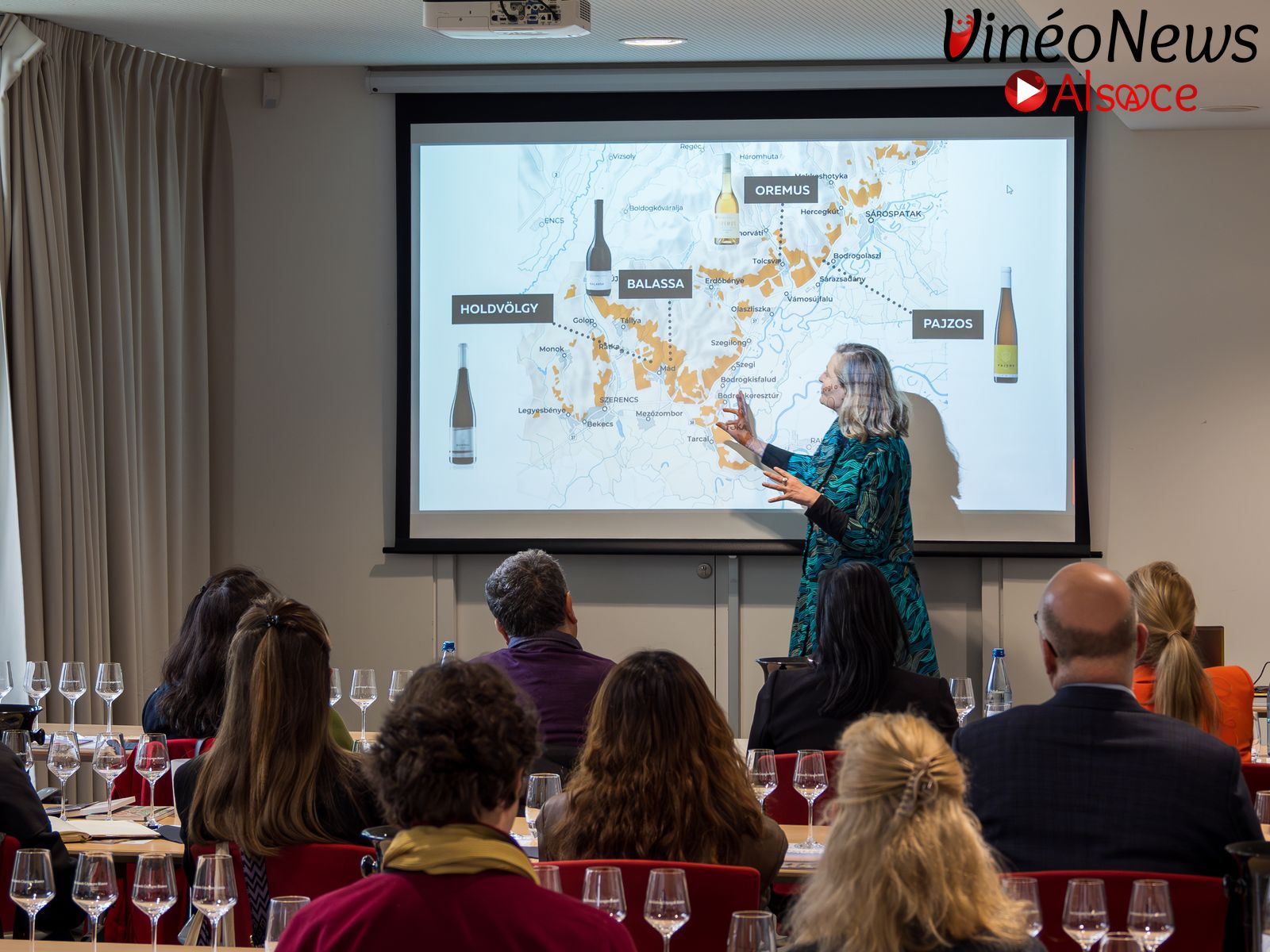
On the occasion of the International Furmint Day, today February 1st, we present Gabriella Orosz's masterclass on this unique Hungarian variety. During the 25th Mondial des Vins Blancs Strasbourg competition, the presentation of Hungarian wines and especially the famous Furmint variety had great interest.
A few words about Gabriela Orosz
Gabriella Orosz, hailing from a family of Hungarian winemakers, has dedicated her professional journey to the world of wine, driven by a passion for sharing knowledge through tastings and masterclasses. Specializing in Hungarian wines, she actively organizes wine events such as the Millésime Festival, Furmint Février France, and Salon des Vins de l'Isère. In addition to her event coordination roles, Gabriella serves as a wine judge and works as a graphic designer/art director at a communications agency specializing in the wine industry. Since 2023, following years of collaboration with Isère winegrowers, this multilingual resident of Grenoble (in the French Alps) has taken on the role of ambassador for Isère wines.
History
Most literature concurs that the variety’s origins lie in Hungary, in the Tokaj wine region. The earliest records of it differ; it is mentioned in the wine region in 1571 and 1623. It was an important variety, once widespread across the entire country, thus also cultivated in what are today neighboring regions, such as Syrmia or Burgenland, albeit in smaller amounts. It is related to Gouais Blanc and therefore also to Riesling and Chardonnay.

Viticultural characteristics
It is characterized by early flowering and late ripening. It has moderately large, evenly lobed leaves and medium-sized, loose, long clusters with relatively thick-skinned berries.
It has become one of the most important varieties over the last few years. If there were one variety that should be put in the spotlight, which is also praised and written about internationally, it would certainly be Furmint. It is a high-quality variety that can be used to make extremely diverse styles of wine. It has already proved itself as a dry white wine and sparkling base wine, and certainly needs no introduction concerning its role in botrytised noble sweet wines.

Where it's grown
It can be found in minute quantities in Austria, around Lake Neusiedl and especially around Rust, where it forms the basis for dry and sweet wines, for example Ruster Ausbruch. It is known as Sipon in Slovenia in reference to the Napoleonic legend.
In Hungary lately, there has not only been more discussion about the variety, but it can also be found in increasing numbers of wine regions, albeit in tiny amounts. Nowadays, it is cultivated on a total of 3,950 hectares. Of course, it’s most widespread in the Tokaj wine region, where it accounts for 65% of plantings, followed by Somló and then the northern shore of Lake Balaton.

What its wine tastes like
The variety generally produces relatively full-bodied wines with high acidity. Its neutral character also means that its dry wines are able to reflect terroir extremely well, especially in the abovementioned areas, while in the case of sweet wines, botrytis provides the foundation for extremely complex Aszú wines in the Tokaj wine region. Its aromas are characterised by quince, peach and apricot. A touch of residual sugar is sometimes left in dry wines to offset the high acidity. It can also be blended with other varieties, such as Hárslevelű or even, where permitted, Olaszrizling. When complemented by the sweet spicy notes of oak ageing, it is an extremely complex variety that has proven its place among other noble varieties.

Gabriela Orosz with the Best Sommelier of the world 1989, Serge Dubs
Wine & food pairing
Furmint is a very versatile variety and can be used to make wines from totally bone dry to the incredibly sweet Essencia, thus extremely versatile for all kinds of everyday and celebratory occasions. Light, simple dry, off-dry, or medium-sweet Furmints are wonderful for everyday drinking. Young vintages are generally a good choice. Serve at about 8-10°C in a tulip-shaped white wine glass to enjoy them at their best.
More serious dry estate wines and single-vineyard Furmints also develop well in bottle, so are worth laying down for a few more years. They also pair well with creamy dishes, soups, vegetables, poultry and game birds, fish and pork dishes. They are best served at around 10-12°C and can be appreciated at their most expressive if drunk from the special Furmint variety glass.
Late-harvested Furmints boast plenty of pure fruit notes, so depending on residual sugar content, they would also work well with light fruity salads, fruity desserts, cream pots and vanilla slices. These wines should be served chilled at 8-10°C in a small tulip-shaped white wine glass or a dessert wine glass.

During the masterclass tasted the following wines

Discover here for further masterclass details:
https://drive.google.com/file/d/1mJaEJePd_nxD8TCFjFfAQIAjhTFqNQdL/view?usp=sharing
Wines of Hungary
Photo Credit:VineoNewsAlsace, Gabriela Orsz