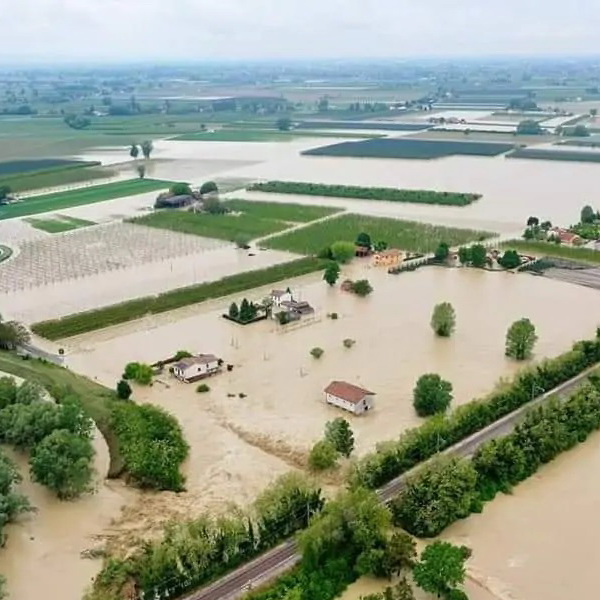
After the storms, a reconnaissance in the territories devastated by floods, but ready to react to difficulties
The alert is not over, the fear is not over, but after three days of rain, Emilia Romagna and Marche try to raise their heads from the mud and, at least, to make a first count of the damage. Difficult, because there are vast plains still submerged by water, and areas very difficult to reach, with landslides that fragment the normal road network, and bridges collapsed under the force of flooding. Dramatic and complex situation, which has obviously not spared any production sector, not even wine, with the vineyards of the plains finished under more than a meter of water, and those of the hills struggling with landslides and washouts. In a picture, to say the least dramatic, destined to worsen again at the weekend, the fear for the vine may seem of secondary importance, but in the territories everything is held and everything is interconnected, from the hydrogeological seal to the stability of the economic fabric.
Narrowing our gaze on the field of our competence, the wine one, the map of damage and concerns takes on different shades, depending on the territories considered, with some elements common to all, especially in the plains: first of all, with the vineyards for hours and hours under water, there is a risk of asphyxiation dynamics of the root system. The greatest criticality, however, concerns the total impossibility of accessing the vineyards with agricultural means to guarantee the plant, in a fundamental moment such as that of pre-flowering, the right phytosanitary defense. In these conditions, in fact, the vine is exposed as never before to fungal diseases, above all downy mildew, which low temperatures are at least slowing down.
To take stock, WineNews heard some of the protagonists of the wine sector of Emilia Romagna and Marche, such as Gianmaria Cesari, at the helm of Umberto Cesari, on the hills between Bologna and Imola, Filiberto Mazzanti, director of Consorzio Vini di Romagna, which embraces the Doc Colli d'Imola, Colli di Faenza, Colli Romagna Centrale and Rimini, among the most affected territories, Claudio Biondi, president of the Lambrusco Consortium, which has its productive heart in the provinces of Modena and Reggio Emilia, and Alberto Mazzoni, director of the Istituto Marchigiano Tutela Vini, which brings together all the denominations of the Marche, where the damage has been more contained, but the concern is still great.
"I do not want to use the word disaster, because it would be ungenerous towards many colleagues from the plains who are experiencing real dramas, both from a personal point of view and from a working point of view", says Gianmaria Cesari. " Listening to colleagues from the provinces of Imola and Forlì, the plants were under a meter of water for 72 hours, risking asphyxiation. In the hills, however, we have to deal with landslides and landslides, which have also dragged with them some vineyards, but it is a situation all in all manageable. Despite drainage and functional drains, however, 300 mm of water in 36 hours - with peaks of 28-29 mm per hour - are impossible to manage. The problem is that after three and a half months of drought the land, 40 centimeters deep, has been unable to absorb water, ending up swelling the rivers and, now, pouring into the sea. As in any dramatic situation, however, the spirit of the people of Emilia Romagna - Gianmaria Cesari is keen to emphasize - has an extraordinary ability to react to difficulties".
The situation, as mentioned, is generally very complicated, especially in the territories included in the Consorzio Vini di Romagna, where, among the less dramatic consequences, but with a high symbolic value for the whole world of Italian wine, there is also the dutiful suspension of "Vini ad Arte 2023", the preview of Romagna Sangiovese and Romagna Albana to the Italian and international media, signed by the Consortium of Romagna, staged on May 30 in the setting of the International Museum of Ceramics in Faenza. Here, "most of the access roads have been blocked by the Civil Protection, and this obviously makes it difficult to have an accurate picture of the situation", says Filiberto Mazzanti, director of Consorzio Vini di Romagna. "There are so many compromised vineyards, so many hilly and mountain roads massacred or even imploded. We recorded two events, each of 36 hours, with the fall of 4-500 mm of rain, even more in the Apennine areas. In often fragile territories, because they are less manned than in the past, sandstone slabs act as an easy sliding surface, and landslides, or rock detachments, lead to the loss of entire stretches of road. The fear now is for the aftermath, for the effects of infiltration and the risks that can follow". Ideally going between the rows, "there are many vineyards where it is difficult to access by mechanical means, and this is a problem: the weather should turn to beautiful in June, with temperatures that will jump to 30 degrees, and downy mildew to spread, so you have to treat. I am thinking of the many biological people, who will have enormous difficulties, and that will be the worst aspect of a situation that does not reach us. I predict huge crop losses, we only hope that there are not many lands affected, but for now it is still difficult to make an estimate, and the sky is always scary ...", concludes Filiberto Mazzanti.
The situation is much better "in the Lambrusco area, namely Modena and Reggio Emilia, which has not had obvious damage such as those recorded in neighboring provinces, such as Bologna, Imola and Faenza", reassures, as far as possible, Claudio Biondi, president of the Lambrusco Consortium. "The exceptional rainfall of these days has led to flooding in the vineyards of the medium and low plains where, to date, it is impossible to access agricultural vehicles to carry out phytosanitary defense, in a delicate phenological phase and particularly receptive to fungal diseases such as pre-flowering. For the hilly area, where there has obviously been no stagnation of water, there have instead been very strong washouts, especially in the territories of Lambrusco Grasparossa, such as Canossa and Scandiano, with erosion phenomena of the vineyards, especially those worked. It's premature to talk about the damage, it will take a couple of weeks to get a full picture."
Another aspect to underline is that with this rainfall "the plant has had an important vegetative activity, so if the apical phase, and therefore the foliar one, were to have the upper hand over the feeding of the bunch, the fruit set could have difficulties, and in that case, the plant would enter into imbalance. Surely we are in a delicate phase, we are therefore at great risk of fungal diseases, such as downy mildew and powdery mildew, but the very low average temperatures for the season may have protected the vineyard. We need to understand how long the weather truce will last, so as to allow winemakers to enter the vineyard and give treatments, because the timeliness of the intervention becomes decisive, especially in organic vineyards, which have fewer weapons", adds Claudio Biondi. Finally, in the area of Modena, Reggio, Piacenza, which have had fewer problems, "there is an unknown factor on the phenomenon of radical asphyxia: if the apparatus remains underwater for many hours, dynamics of asphyxiation of the root system could be determined".
Finally, the situation of the Marche, where the apprehension, for the wine world, is linked "to the impossibility of returning between the rows in order to guarantee the vine the necessary phytosanitary treatments, especially in the many hectares of organically run vineyards that we have in the Marche, a problem that, with the persistence of bad weather and rainfall, is likely to worsen further ", explains Alberto Mazzoni, director of the Istituto Marchigiano Tutela Vini, recalling that in a few days "160 mm fell, out of the total 700 mm that fall throughout the year. The persistence of this humidity, accompanied by mild if not warm temperatures, favors the development of downy mildew. We are in a very delicate phenological moment, so great attention is needed, but at the time of entering a vineyard with the tractor we do not even talk about it". That of the Marche producers, however, is not apprehension, but "modest concern", reassures Mazzoni, giving an optimistic reading, in the awareness that "at this moment there is very little to do, we can only wait, managing the pressure of fungal diseases carefully. Certainly, there was no need for all this water, in the Marche drought was not yet a danger. We must be balanced, knowing that ours is a region with a high biological vocation, so the danger is greater: we have given ourselves a specification that complies with Community regulations, but the combination of heat and humidity creates the ideal conditions for downy mildew. The hope is that the sun will soon return to dry the vineyards...", concludes Alberto Mazzoni.
Source: Winenews.it