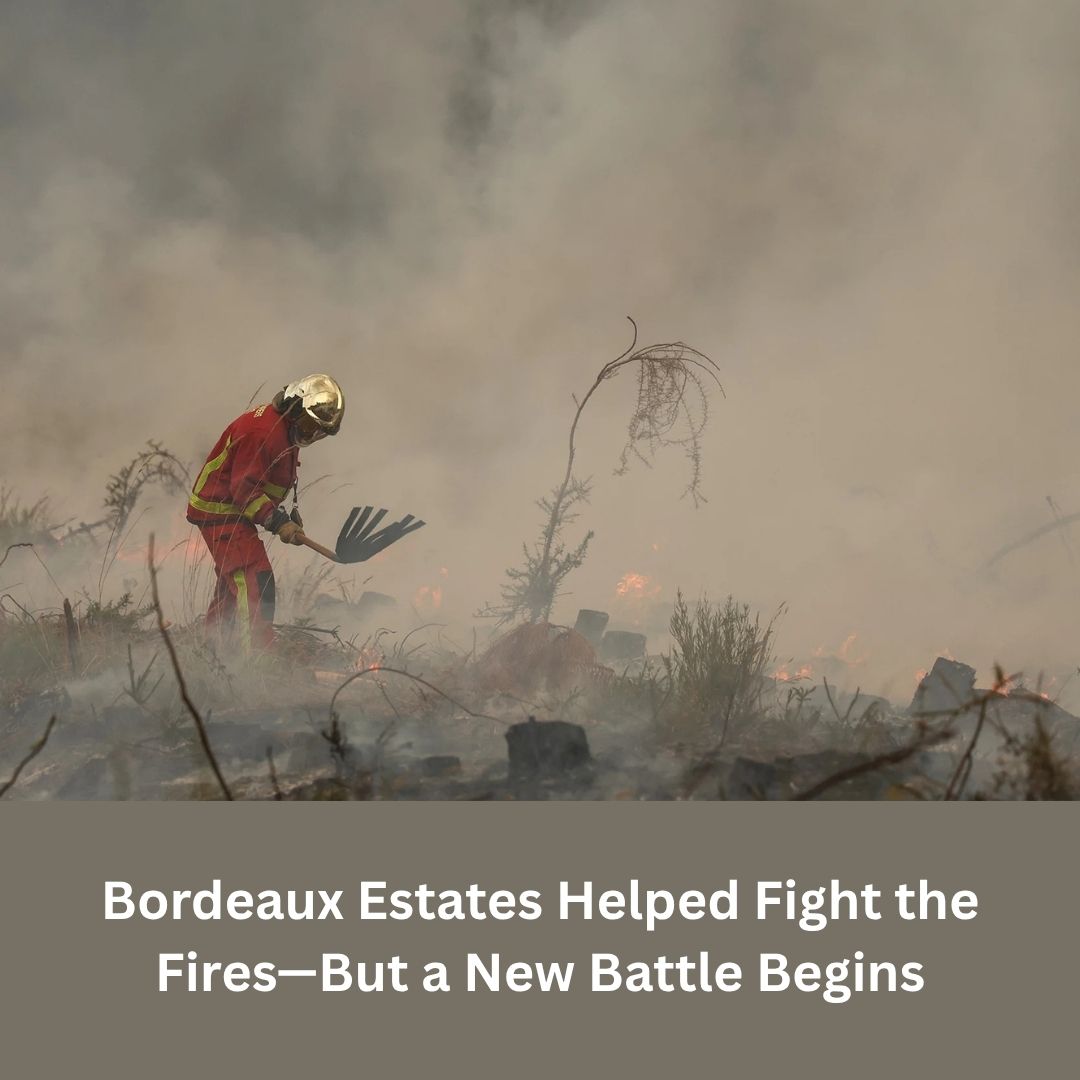
A firefighter of Paris Fire Brigade strikes the smoldering debris with a shovel in Marcheprime west of Bordeaux on July 26, 2026 as a wildfire has been ravaging the forest north of the Arcachon Basin (Gironde) since July 22. Photo by ROMAIN PERROCHEAU / AFP via Getty Images
- Massive wildfires burned 103,000 acres near Bordeaux, forcing evacuations and threatening nearby towns and key infrastructure.
- Local winemakers dispatched equipment and staff to assist exhausted firefighters, successfully protecting the region’s major vineyards from fire.
- Bordeaux growers expect an early 2026 harvest with minimal smoke taint, though long-term climate threats and declining tourism worry producers.
One of the most arresting images to come out of the wildfires that have threatened the Bordeaux vineyards is of horses.
The viral video shows a herd, set free to escape the fire, racing down a street in the village of Biscarosse, away from the cloud of smoke and the raging orange flames. While all the horses are safe, the scene epitomizes the drama that has been unfolding in southwest France.
Fires have burned up 103,000 acres of pine forest and small villages close to the Atlantic coast of France, sending residents and tourists fleeing and threatening the city’s outer suburbs and major aerospace and military facilities.
While there was no immediate threat to vineyards north and south of the city, in the Médoc and Graves regions, there is real concern from the smoke spread by the winds from the fires. Owners have so far reported no fire losses. Bordeaux vineyards sprawl across 233,000 acres, covering five times more ground than Napa Valley.
An optimistic Philippe Castéja, president of the Conseil des Grands Crus, points out that “no vineyard has been touched and experts have said there is no noticeable effect on the vines.” Guillaume Gonfrier at Vignobles Gonfrier in the southern Entre-deux-Mers, an hour east of Bordeaux center, told us, “I remain confident in the 2026 vintage.”
While the fires are certainly not out (that process will take months), they are contained. And while the region’s growers may still be on edge, they can breathe a sigh of relief.
But as Europe gets hotter and drier, and fires become more frequent, Bordeaux estates can’t help but worry about what comes next.
A Wine Community Joins the Firefight
As the blaze spread at an alarming pace, most intensely between July 25 and 29, the region’s elite vineyards didn’t just sit back—they actively joined the firefight.
Winemakers dispatched tractors to haul water, offered private water cisterns to local crews, sent farm staff to the front lines, and set up coordinated estate networks to respond to new outbreaks. Vine growers rushed to help the stressed and exhausted firefighters with offers of equipment and distributing water.
South of Bordeaux city, at Château Haut-Bailly in Pessac-Léognan, director Véronique Sanders said on Wednesday it was “heartening to see how all the growers are coming to help fight the fire.” Although, she emphasized, the fires have shaken the community. “We had a little smoke on Saturday and now we don’t know if the fires will flair up again,” she said. The vineyards were not affected by fire.
At nearby Château Smith Haut Lafitte, director general Fabien Teitgen says the property has a number of water cisterns they have “put at the disposal of the local firefighters.” They also have emergency plans to remove the animals in their farm but the fire did not come close.
Further north, at Château Margaux, deputy managing director Aurélien Vallance, says the estate has sent staff to assist the firefighters. At Château Giscours in Margaux, they sent tractors and other equipment to ferry water to the firefighters. Says Vallance: “We are working closely with other estates to coordinate any response if the fires should come closer.”
The State of the Harvest
Bordeaux wine country may have averted immediate and catastrophic disaster, but what of the 2026 harvest?
Because of the increasingly hot, dry weather, it will be an exceptionally early one. “We could start harvesting the whites for Pavillon Blanc in about 10 days [on August 10], and for the reds by the end of August,” says Vallance. The risk then is any smoke could affect the red grapes in particular.
Thankfully, wine growers of Bordeaux play down the risk of smoke taint for the harvest. “It’s nothing like what happened in California with the 2020 vintage,” says Vallence.
Moreover, at a time when the Bordeaux wine sector was already struggling with plunging consumption, a hit to tourism could be grave. “Tourism was really the only dynamic part of the business that was still growing, both for us and, more generally, for Bordeaux wines,” winemaker Edouard le Grix de la Salle told PBS. “And now this comes along as a brake.”
Source: Wine Enthusiast by Roger Voss
Photo Credit by ROMAIN PERROCHEAU