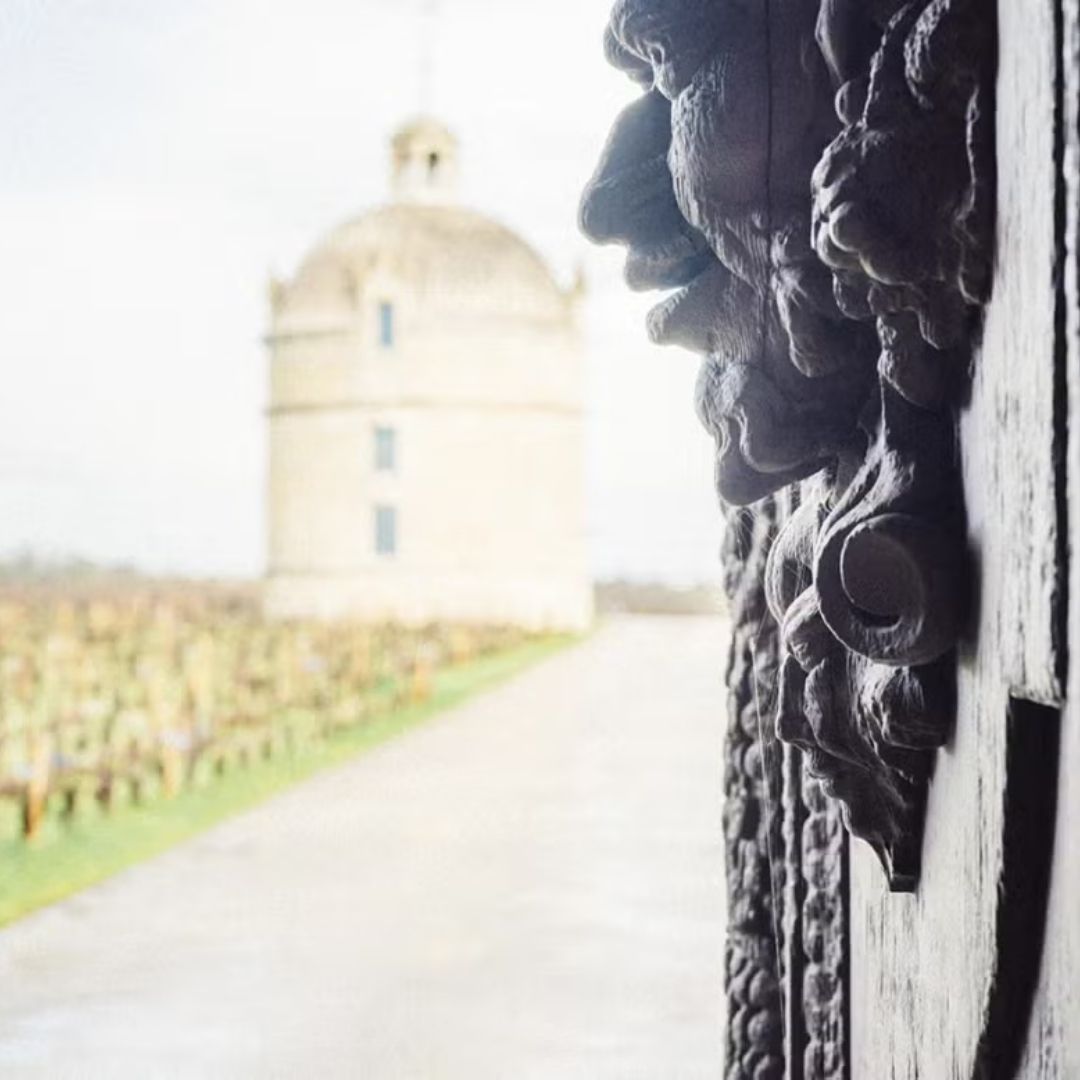
Perhaps Lafite can claim more glamour, Margaux more romance, and Haut-Brion more history, but Latour has always had a sort of solid, noble dignity. You could describe it as Saintsbury described Hermitage: “manly.” Its wines start life rough-hewn, uncompromising, unsmiling. When a smile eventually emerges, it is no chummy twinkle; more the revealing of a considered beneficence. You feel privileged that such a stern authority should bestow such warmth on you.
That was my impression of Château Latour as a claret lover who had rarely tasted it. Each encounter had confirmed the feeling that it stood apart. Comparisons didn’t really work. You might say (rarely) that Lafite (or Latour) had had a more successful year but not that it had made a better wine. Lafite has never made a better Latour, or vice versa; could Judi Dench do a better Maggie Smith?
When, in 1986, I was invited to join the Latour board, the Conseil de Gérance, I was quite unprepared; delighted, of course, but apprehensive. What could I bring to the party? The de Beaumont family—inheritors from the “Prince des Vignes,” the Marquis de Ségur, in the 18th century—had sold the majority of their holding in 1963 to what was described as “Lord Cowdray’s interests.” Cowdray was chairman of the Pearson family’s business (which included the Financial Times). The Pearsons arranged for a quarter of the shares to go to Harveys of Bristol, then one of Britain’s major wine merchants. They appointed David Pollock, a board member, as president of the Société Civile de Château Latour. It was the de Beaumonts who had coined the notion of the Société Civile in 1842, as a means of protecting themselves from the obligation to divide their inheritance. The de Beaumonts didn’t disappear; they still held an important share and were represented on the board by Comte Philippe de B.
David Pollock was the first British chairman, overseeing a huge investment to bring the property into the 20th century. He was succeeded by Clive Gibson, another Pearson family member, who was succeeded as president by the Honorable Alan Hare, again a family member and retired chairman of the FT. It was he who invited me, out of the blue, to lunch one day at White’s, his St James’s club (and the grandest of all). Would I join the board, for a modest fee, my reasonable expenses, and an annual allowance of wine? I didn’t hesitate, though I was overcome with a feeling of déjà vu. Alan’s elder brother John, Viscount Blakenham, had given me lunch at the next table ten years before to pop another question: Would I join the Publications Committee of the Royal Horticultural Society, of which he was treasurer, to advise on the Society’s Journal ?
A new regime
When the de Beaumont clan sold Latour in 1963, the word on the street was that it was in a bad way and needed serious investment. On my first visit there, Monsieur Brugière, then the régisseur, had shown me around the shuttered château. I remember the peeling wallpaper with the flower prints of a maid’s bedroom. Apparently, Comte Hubert de Beaumont, on his rare visits, slept on a camp bed. The equipment in the chai looked as old; the vines, of course, were aging, too.
When people say what improvements the British brought, I smile. Latour had just produced two of the greatest vintages of the century, 1959 and 1961, with a very respectable 1960 in between and an excellent 1962. So much for decline. The shareholders in reality were hugging themselves. They had never seen such prices, the property was worth many times their previous estimation, but it was desperately in need of investment. There were scores of shareholders, mainly members of the related de Beaumont and de Courtivron families. They had the most predictable reason to sell: reluctance to see dividends consumed by capital investment.
Unfortunately, 1963 was not a propitious start for the new regime. The weather was dismal. Latour struggled to keep up its reputation (generally deserved) for making a respectable wine in a rubbish year. 1964 was crucial. Pearson (the company) had made a huge investment. The old oak vats had gone; stainless steel now glittered in the cuverie. Only Haut-Brion, of all the first growths, had braved this radical step before. But it was not just the equipment: Pearson had already bought more land and buildings and set about restoring the vital drains in the whole vineyard. The summer was fine, the grapes ripening well, when weather warnings came in from the Atlantic. Latour was taking no risks and started to pick, while other châteaux were still contemplating what the government had already called the vintage of the century. The rain started on October 8 and didn’t stop for three weeks. Of the top châteaux, only Latour and Montrose picked early enough to escape the delu
The little château of Latour is really nothing of the kind. It’s a courtesy title for a bourgeois house that would hardly be noticed in one of the smarter Paris suburbs. The de Beaumonts had largely ignored it, but to the new English owners it was their HQ and, above all, their place to entertain. A London decorator was let loose and, within the awkward confines of a building with too much symmetry and not enough space, contrived a cozy salon, a study, and a dining room with red walls, big enough for a party of ten or so. The front door leads into a narrow hall that goes straight through to the garden door and steps down to a potential place to eat outside—something then considered eccentric, even risky, in France. Upstairs there are four main bedrooms, of which the yellow room, facing the river, became a familiar home to the Johnsons. The most important room, the kitchen, is beside the dining room, above a surprisingly modest wine cellar. But then the chais with their stock of 50-odd vintages are a short walk away through the vines.
Alan and Jill Hare were gracious and cheerful hosts who kept a steady procession of variegated guests flowing through the house and enjoying the admittedly limited amenities of the estate: vines, chais, a walk down to the River Gironde, the meadow where a few cows passed their uneventful time while the brown tide, a mile or so wide, crisscrossed to and fro twice a day. There was usually a ship in sight but rarely a big or beautiful one. Jill Hare was an enthusiastic gardener and soon pressed me—with my gardening knowledge gleaned from ten years of scribbling—to offer my opinion. There was a great deal that simply needed clearing away.
The little garden at the foot of the steps was entirely cut off from the world, the vineyards, and the view of the river, by a ten-foot (3m) hedge, presumably to screen privileged guests from the eyes of the vineyard toilers. Watching others toil, though, as some guests remarked, is a privilege and pleasure. The hedge went, and toilers could enjoy the sight of guests being pampered. North of the château, too many trees totally shaded a slightly larger garden whose central feature was a henhouse. Deciding which of a mixed bag of spindly trees to fell was not easy, but the end result was satisfying. Then came a plan for a little garden à la française, while out in the landscape we took a saw to all sorts of unfortunate choices.
It was perhaps not surprising that someone had thought the appropriate tree to plant as a screen to the tractor sheds in the middle of the view was one with red leaves; worse, one of those maroon-dyed cherry plums of suburbia that have an early moment of pink blossom, then grow more and more funereal as the year goes on. They had to go, to be replaced by “proper” trees, mainly the indigenous ash that populates the riverbanks. There were many more alterations and eliminations to simplify the prospect and make sure it was the vine rows that are the center of attention. One idea I stole from Château Lafite, where Elie de Rothschild had planted a row of weeping willows along the main road to half-screen the château. I planted half a dozen weeping willows by the back gate, on the little road north of the vineyard. Today, they are quite impressive trees.
An English country-house party with a fabulous cellar
Pearson had wisely chosen two prominent Médocains to run the property, selected for their experience and practical advice: Jean-Paul Gardère and Henri Martin, the mayor of St-Julien and creator of the outstanding new St-Julien cru bourgeois Château Gloria. The old family was represented by a gracious but modest Philippe de Beaumont.
Jean-Paul became régisseur—the Bordeaux term for agent, steward, or manager—next in a long line of famous figures who had done the chateau’s business for 300 years. His humble origins as the son of a resin-tapper in the pine forests had not stopped him becoming one of the most respected brokers in Bordeaux. With him, he had brought his own business, Ulysse Cazabonne, which became a major player in the sales of Bordeaux.
The British team were Alan Hare, Harry Waugh, and me. Harry could be called the creator of modern Latour. As the presiding genius of Harveys of Bristol, he made the great decisions on how to run the estate and directed the necessary—and vast—investments. Harry was generally considered one of Britain’s (and the world’s) great authorities on claret, besides being universally loved for his personality. It was he who opened up the American market—obsessed as it then was with Rothschild wines—to Latour, meeting wine lovers and giving tastings all over the country. He even found time to introduce Beaujolais to Britain. Why was I recruited? It’s not for me to say.
If Harry was dynamic in business, he was also the epitome of the old-school wine trade; he simply would not have understood the modern obsession with adjectives—let alone scores. A Harry tasting note would be “Good colour; bright. Quite aromatic. Good body. Nice wine. Perhaps a bit like the ’66. That would be nice.” At some point when he was in his 80s, he was in a car accident that shut down his sense of smell. His acute sense of taste and texture somehow took over. Knowing that it was Latour he was tasting, he would hand the glass to Prue, his wife, to sniff, and take her word for it that there were no surprises. He assessed the weight, the ripeness, the acidity, and tannins on his palate. There was no fooling him.

The board met alternately in London and at the château. We heard reports on the weather, progress in the vineyard, activities in the cellar, the vital figures of yield—how many bottles of grand vin, how many of Les Forts de Latour, and how many were relegated to mere Pauillac de Latour or disposed of “in the trade.” 1986 was my first vintage. The directors tasted regularly with the maître de chai and the chef de culture. I remember tasting the wine of this unremarkable vintage that had been excluded and protesting that it was surely worth bottling. To me, it had the unique Latour flavor, if not in abundance. Some of it became Pauillac de Latour, with a simple printer’s label, no embossing or gold. I gave some bottles to friends in England and never really expected to see them again. Thirty years later, one of the friends brought one to an opera picnic at Garsington. I was amazed to see it and opened it without high expectations. It was firm, forthright, and even fresh—certainly losing its fruit but unmistakably a Latour. Class will out.
Lunches and dinners in the château were memorable. All of them. We had the best chef in the Médoc, the quietly genial Bruno. He welcomed us to his kitchen to watch his endlessly painstaking operations. It was here that I learned the difference between cooking and cuisine. The deliberate construction of flavors and textures that might pass as simple at table, were irresistibly delicious to eat, but never existed in nature is surely France’s unique contribution to civilization. I will quote one of Bruno’s menus for an “ordinary” dinner, on October 4, 1990: roulade de saumon aux crevettes, with Puligny-Montrachet Les Champs Gains 1986; selle d’agneau rôtie au romarin, pommes sautées, Les Forts de Latour 1979; fromages, Château Latour 1959; framboises à la crème. We normally started with a glass of Champagne, often Pol Roger, had either a glass of white Graves (more rarely Burgundy) or a light vintage of Les Forts with the first course, then often two vintages of the grand vin, one a well-known one and the other from a “lesser” or neglected year—which rarely failed to be much better than we expected.
Regular guests at lunch or dinner parties often included the remarkably few proprietors of great châteaux who actually lived on their properties. Anthony and Eva Barton at Langoa, of course; Jean-Eugène and Monique Borie of Ducru-Beaucaillou; Christian Moueix; and sometimes the man we considered the prince, duke, or whatever is appropriate of St-Emilion, Thierry Manoncourt of Château Figeac and his wife Marie-France. Sometimes Martin Bamford would come down from Château Loudenne. We had excellent company—indeed, the vibe of Latour was not unlike an English country-house party with (much) better food and a fabulous cellar.
There were visits to neighboring châteaux, of course, and we once went up in a helicopter to inspect the vineyards from above. We had a shock. In many famous properties (this was in the 1980s), the vine rows visible from roads, or from next door, were full of healthy vines. But parts of the hidden center were virtually bald, with more than half the vines missing. Yield quotes as “per hectare” would be very far off the mark.
Perfection and the bottom line
Our much-loved president retired, alas, ill with cancer. His successor came from the heart of the wine trade with decades of practical experience and a different approach. David Orr had spent years in Portugal and Spain running Cockburn’s before becoming managing director of Harveys of Bristol. I’ve never quite kept abreast of the various takeovers that plagued the wine trade in the 1980s and ’90s. The Hiram Walker Group merged with Allied Vintners and took David to New York and California. He ran Frederick Wildman’s importing business in New York and, among other wineries, Clos du Bois in California. Judy and I had known him and Susan, his wife, for years. Jean-Paul Gardère retired, to be replaced by Christian Le Sommer, not the son of the soil Jean-Paul had been but a bright and competent manager who has since seen service as a consultant with the Rothchilds’ domaines in France and South America.
My memory is poor on the precise dates of staff changes, but when Christian came, we were also looking for a commercial director. I had just visited the thriving co-op at St-Emilion, Royal St-Emilion, and been shown around by manager John Kolasa: I was so impressed by this Hiberno-Frenchman that I proposed his name for an interview. Christian and John made a harmonious team; they stayed at Latour until the great change of regime in 1993.
The part of the board meetings that interested me least was the financial. I remember being surprised to be told that a yield of 2.5% on capital was considered a good result. Each meeting made a decision on the dividend going to the shareholders. Even a fraction of a share (which many had) seemed to me a pretty desirable asset. Things changed radically when the major shareholder became a public company. Hiram Walker took a different view from personal investors. As I understand the situation, questions were asked (presumably) by investment funds about why the company was bothering with such a non-core little business as a French wine estate when its profits from its usual distilling businesses were on a different scale. The instruction came down from on high that we (the Conseil de Gérance) had to find a buyer for our priceless first growth. It was raining that morning. For some reason, the directors were in a minibus out in the vineyard. Michael Blakenham was with us; he was Alan Hare’s nephew and at this time on the board. It was he who broke the news. We, the conseil, immediately instructed Lazard Frères, the Paris bank that did Pearson’s business, to come up with a shortlist of possible buyers within two weeks—in strictest secrecy. Next morning, it was on the front page of Le Figaro.

The likeliest buyer turned out to be the two Wertheimer brothers who own Chanel—and much else. Negotiations began, and dragged on. They would pay for the château, then the vines (I don’t remember the precise detail), the stock, the new wine… in instalments. Did they not realize that opportunities to buy a first growth come up once in a generation? While they negotiated, François Pinault made up his mind. He (or rather his company, Artémis) would pay the asking price at the end of the week. The deal was done.
As a postscript, David Orr advised the disappointed Wertheimers that if they couldn’t have a first growth, there was a splendid second growth also going cheap. Château Rausan-Ségla in Margaux had been in the doldrums for years. Perhaps it lacked the status of Latour, but the potential of its vineyards had been proved ever since it was founded, as close to Château Margaux as possible, in the 17th century. The Wertheimers bought it, and shrewdly took on David as gérant. David in turn brought John Kolasa on board and, with a master touch, Bruno the chef. From that moment, the fortunes, the wines, and the amenities of Rausan-Ségla began to justify its ancient fame. Bordeaux and its wine evidently grew on the brothers. Two years later, David led them to another property that was lagging behind its peers, Château Canon on the côtes of St-Emilion.
There was radio silence from François Pinault. Most of the conseil were given their congé, but Harry Waugh and I heard nothing. After a while I wrote saying I would be in Paris; would he have lunch with me? The reply was that I should go to the three-star restaurant where he apparently had his lunch every day. I found a stocky, warmly smiling man of about my own age, sitting at table with the finance director of Artémis, the formidably elegant Patricia Barbizet. I asked what may have sounded a silly question: Why did he buy Latour? Because he could, easily, he said. As soon as he heard there was a chance he looked in his wallet—et voilà.
Harry and I remained on the board for a couple of years. Meetings were in Paris, at short notice. After I had unavoidably missed two of them, I was very politely told that M Pinault expected his directors to pull their weight. That was my congé.
Meanwhile, the priorities and the tone of the château changed almost out of recognition. It was no longer a matter for amateurs. The chef, the gardener, and the chauffeur, those emblems of comfort, were congéd. It was clear that Artémis had two priorities—perfection and the bottom line—and they needed no bankers to help. Pinault had found (I don’t remember how) a fanatical young wine lover called Frédéric Engerer. His contribution on the conseil made me feel very amateur indeed.
François Pinault and his wife Marivonne were exceptionally generous. In 1995, Decanter made me their Man of the Year. Sarah Kemp hinted that a celebration at Latour would be acceptable. The Pinaults immediately offered a lunch for as many guests as we could fit in the big reception room. I think we were 40. What were my favorite Latour vintages? Taking a deep breath, I said 1959 and 1949 (two of the greatest years of the century). “Fine,” said Pinault. They were served with a perfect Bordeaux meal; two of the best wines, in the best company, of my life. Most touching of all, Marivonne (a passionate gardener at their château at Rambouillet) came down from Paris by train with boxes and baskets of flowers to decorate the tables.
The world knows that the Pinaults have spared no trouble or expense to maintain Latour as the pinnacle of Pauillac (and, in my opinion, the wine world). Since my day, every facet of the property has been renewed. It wears a far more fashionable and modern air. There are three flagpoles on the way to the chai. They used to fly the tricolor, the Union Jack, and the national flag of a current visitor. When the Pinaults arrived, up went the pirate flag of St Malo, where the family originated—in the timber business, according to official sources. But Pinault once told me, smiling, as pirates.
Hugh Johnson
One of the world’s foremost authorities on wine, Hugh Johnson OBE is among many other things known for his global bestsellers The World of Atlas of Wine and the annual Hugh Johnson’s Pocket Wine Book.
Τhe article published in Château Latour: Some memories - World Of Fine Wine