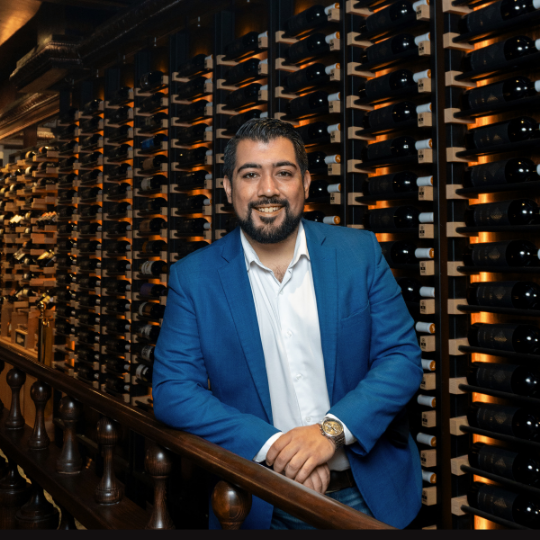
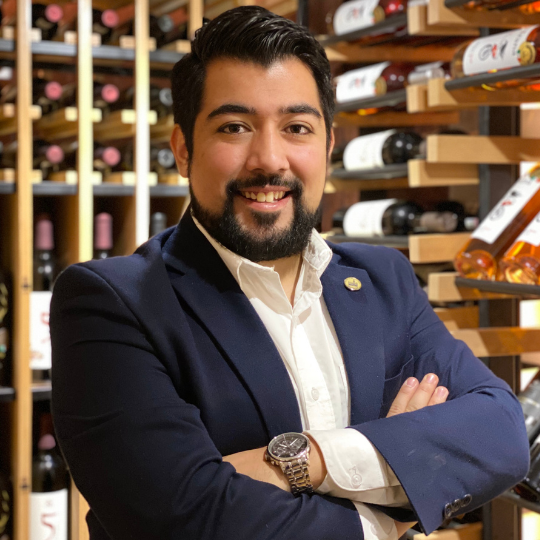
Honored and proud to present Manuel Negrete the internationally recognized Mexican sommelier, wine educator, and judge with certifications from ASI, WSET, and the Court of Master Sommeliers. He has represented Mexico in international competitions and worked with organizations such as the Association de la Sommellerie Internationale and the Concours Mondial de Bruxelles.
You began your sommelier training at just 21—what drew you to the world of wine so early, and what has kept you passionate about it ever since?
While I was pursuing my bachelor’s degree, I was looking for a job as an administrative assistant to earn some money and start putting into practice what I was learning in school. That’s when I had the incredible good fortune to start working with sommeliers and see what this world was all about, since in Mexico in 2010, the world of wine was much less well-known, and very few people actually made it their career and way of life. Omar, Fernando, and above all, Marcos, were the ones who opened the door to this wonderful world for me, and I was always captivated by the fact that it involved subjects like biology, chemistry, history, and travel. Above all, I’ve always seen it as a way to understand human beings and their culture through this liquid. There’s always something new to learn, and that’s what I’m passionate about—sharing and discovering new things every day.
From working with Freixenet to leading roles in international organizations like ASI, how have these diverse experiences shaped your philosophy as a sommelier?
Throughout my career, I’ve had the opportunity to learn in many ways—from carrying boxes and stocking wine shelves, to recommending wines to customers at the stores where I worked, and later on, training service teams. I’ve also gained international exposure by attending events organized by ASI, such as regional competitions, the ASI Best Sommelier of the World, and of course the bootcamp that is now held periodically, all the way to serving in the dining room during my time as Wine Director at the Wine Bar by CMB and judging the CMB itself—everything has contributed to giving me insights from different angles of this industry, which I really appreciate. This way, you don’t have a tunnel vision, and it allows you to re-think the decisions I make and recommendations I give, thanks to the perspectives I’ve gained.
You’re one of only a handful of Mexican ASI Diploma holders—what did that journey demand from you, and how did it transform your understanding of wine?
The ASI Diploma is gaining ground and becoming more popular in the wine world because it’s a truly demanding certification; I think it’s a major challenge that involves knowledge, service, and a sense of hospitality. I definitely think it was really difficult, and now, almost 10 years after I earned it, I can see just how hard it still is for candidates to obtain it. We’re certainly always focused on the goal of earning a certification, but I believe the journey is what matters most—whether it’s to earn a diploma, compete, or gain new recognition, you never lose; you always learn something new and strive to improve as a professional.
Winning the ASM Master of Champagne Competition and representing Mexico internationally are major milestones—how do you approach high-level competitions, and what do they teach you beyond technical skill?
Training is always important; you start preparing months in advance: theory, blind tastings, reading about producers, vintages, and iconic wines, spirits, water, cigars—all sorts of things. That’s why competing at least once greatly enriches your experience, because it compells you to study things that you might otherwise overlook or pay less attention to.
And above all, the best part is always the people you meet—other professionals with the same hunger and desire to keep learning—and, of course, that competitive spirit, but also the camaraderie among people from different countries who are all striving toward the same goal.
As the only official wine instructor in Mexico endorsed by Ningxia’s grape industry, how do you see emerging wine regions influencing the global wine conversation?
Today, climate change and technology have led to various countries making their mark on the wine world, whereas perhaps 30, 20, or even 10 years ago, they were heard of much less frequently.
Countries like England, Belgium, Brazil, Japan, or in this specific case, China, have begun to make a name for themselves as serious wine producers, and you can see it in the dedication and seriousness with which they have set out to produce and position the wines of their regions.
I really like that, because I believe that great value lies in syncretism—in sharing and discovering products from different parts of the world. The same is true for Mexican wine; very few people worldwide have tried Mexican wine yet, but the vast majority who do are surprised by the quality found in its bottles.
This has helped boost local industries, of course, but it has also encouraged producers in more traditional wine-producing countries to focus on the essence of what has defined them for many years: terroir.
No one disputes the great, traditional producers; we all have clear references for the wines that define a grape’s traditional style. Yet diversity allows us to always experience the expression of a specific location where passion and hard work seek a place in consumers’ hearts.
You balance multiple roles—educator, judge, writer, ambassador—how do you stay grounded, and what continues to inspire you personally and professionally?
Just as I was saying, in the world of wine and beverages—and beyond, in the realm of hospitality—there’s always something new to discover, something new to try, some unfamiliar technique to understand, and the best part is sharing it, always. So I think anyone who realizes this can understand that, in reality, we know very little about many things, which helps keep us grounded.
For me, there’s a Latin phrase that sums it up: “Pedes in terra, ad sidera visus” -Feet on the ground, eyes on the stars.
Editor Marinos Skolarikos